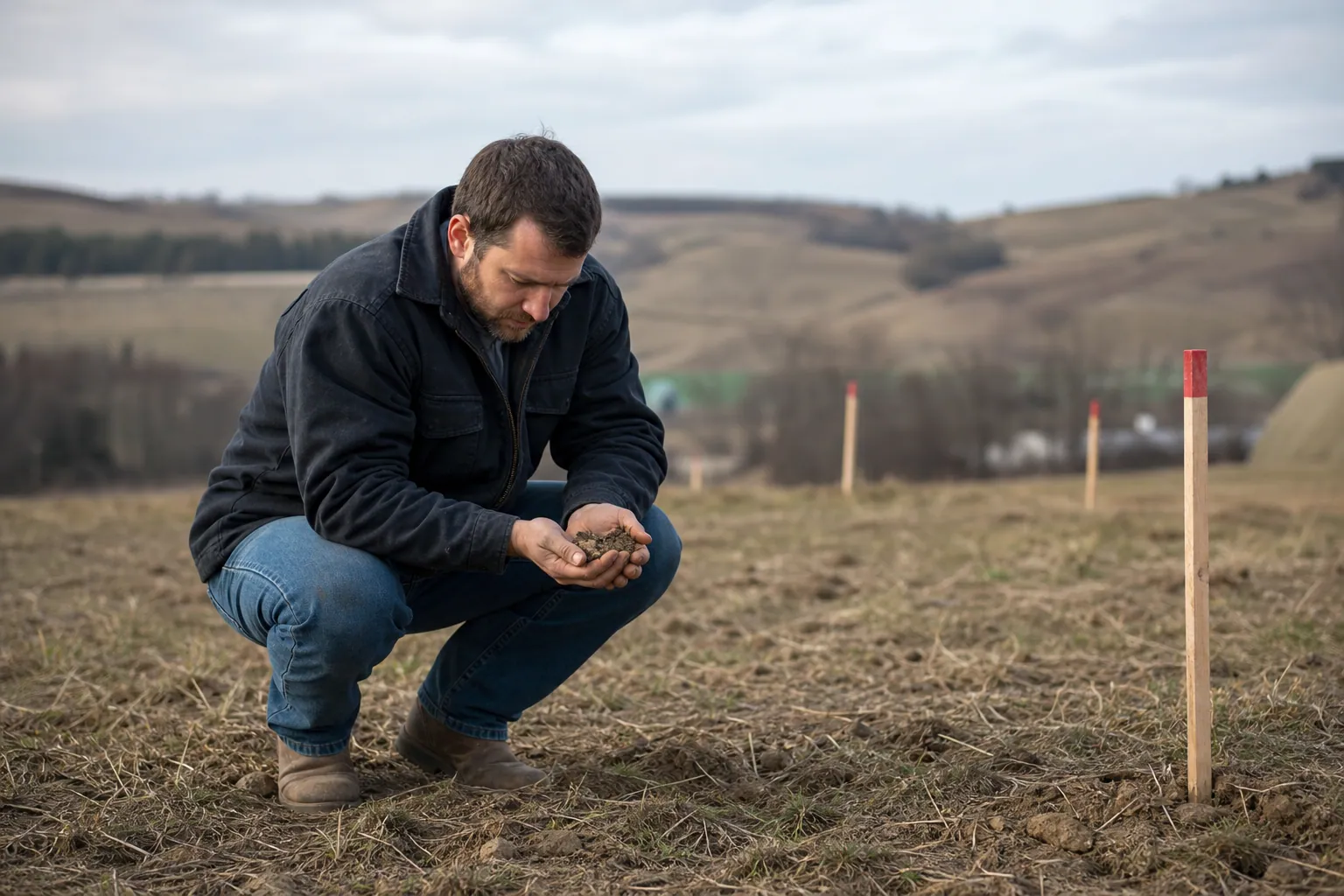
The dirt under a lot determines more of your build budget than anything you can see from the road. Uncompacted fill can't carry a foundation, buried stumps rot and leave voids, expansive clay cracks slabs, and a high water table can sink a basement plan entirely. Any one of these can add $20,000 to $80,000 to a build — after you already own the problem.
The good news: soil problems usually telegraph themselves if you know where to look. Here are seven warning signs you can check yourself before closing, what the fixes actually cost in 2026, and a simple rule for deciding when to pay for test pits or a geotechnical report.
Signs you can read from the street
Start with the shape of the land. Graded lots are often sold as a convenience, but grading is also how problems get buried.
- 1. A suspiciously flat pad on a sloped lot. Flat spots on hillsides are made by cutting soil from one side and filling the other. The cut side is fine to build on; the fill side isn't — unless the seller can produce compaction test records from the grading work.
- 2. Waves, dips, and soft hollows. Ground that has settled unevenly is telling you something underneath is decomposing or compressing, often stump holes or loose fill. Undisturbed ground doesn't ripple.
- 3. Vegetation that doesn't match the neighbors. Stunted, patchy grass often means debris or junk soil close to the surface. Cattails, willows, or a stripe of lush green in a dry season mean water sits high.
Signs you find with a $15 shovel
Bring a spade and permission to dig a few holes 12 to 18 inches deep inside the likely building footprint. Ten minutes of digging beats an hour of speculation.
- 4. Man-made debris in the soil. Brick fragments, concrete chunks, asphalt, wire, glass, or wood scraps at the surface almost always mean more below. Demolition debris was routinely buried on-site for decades, and it's expensive to chase out.
- 5. Soil that doesn't behave. Gray, greasy soil that rolls into a ribbon between your fingers is clay — and if it's mottled gray and rust-orange, the water table visits regularly. Soil that pours off the shovel loose and fluffy is fill that was never compacted.
Signs hiding in the paperwork
Two of the most reliable signs never require a shovel. Both take about twenty minutes online or on foot.
- 6. The lot has a past. Pull historical aerial photos from the county GIS site or Google Earth's timeline view. An old farmstead, a demolished house, a filled pond, or a former gravel pit means buried foundations, septic tanks, or organic muck.
- 7. The neighborhood confesses. Walk the street: stair-step cracks in brick, tilted retaining walls, wavy driveways, and a sump pump humming in every garage are area-wide soil symptoms, not one-off bad luck. The USDA Web Soil Survey is free and will flag expansive clay and seasonal high water for the exact parcel.
What these problems cost to fix in 2026
Here's what the downside looks like, so a $2,000 investigation has context. These are typical 2026 ranges for residential lots; local labor rates and haul distances move them.
- Digging out bad fill and replacing it with compacted structural fill runs roughly $25–$50 per cubic yard in place; typical residential fixes land between $10,000 and $60,000.
- Helical piers to bypass weak soil cost $1,500–$3,000 each, and a modest house can need 12–20 of them.
- Building on expansive clay usually means a post-tensioned slab or drilled piers — figure $15,000–$50,000 over a standard foundation.
- A high water table can force a raised pad and foundation drains, and it sometimes kills a conventional septic design outright.
When to pay for test pits or a geotech report
If a lot shows any two of the seven signs — or it was graded flat shortly before listing — investigate before closing, not after. Test pits are the fast, cheap answer: a licensed excavation contractor like Acme Excavation can dig three to five pits 8–12 feet deep in a morning, typically $800–$1,500 all-in. You'll see exactly what's down there, including where fill stops and native soil starts.
A geotechnical report goes further: an engineer drills borings, tests samples, and gives you written foundation recommendations. For a single-family lot, budget $1,500–$4,000 in 2026. If you're planning a basement, building on a slope, or the soil survey flags clay, it's worth every dollar — and many lenders and building departments will require one anyway.
Make the dirt the seller's problem
Write a feasibility contingency into your offer: 30 days, access to dig test pits (with restoration), and the right to walk with your earnest money if the soil fails you. Sellers of good lots rarely object; sellers of buried problems often do, which is an answer in itself.
None of this is exotic — it's a few hours of walking, digging, and reading, plus a modest check if the signs stack up. That's the cheapest foundation work you'll ever buy.