


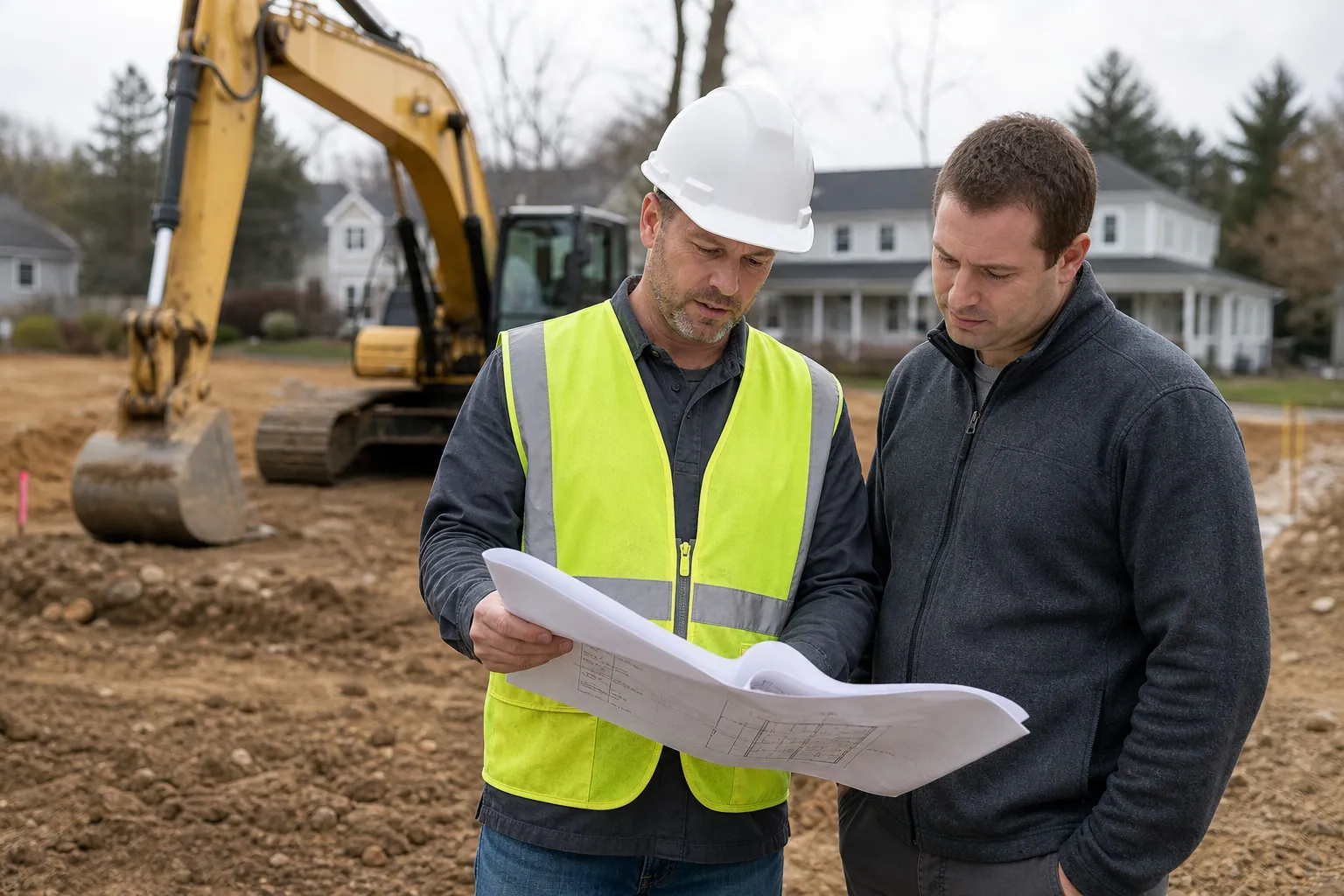
Hiring an excavation contractor is one of those decisions where the cheapest bid can become the most expensive mistake. The work gets buried the day it's finished, so you can't inspect your way out of a bad grade, a crushed drain line, or a footing set on soft fill.
The fix is to vet before anyone mobilizes. Good contractors answer these nine questions without flinching — and the ones who dodge them are telling you everything you need to know.
First, ask for the contractor's license number and look it up yourself. Most state licensing boards have a free online search that shows status, complaints, and bond information in about two minutes. If your state licenses at the city or county level instead, one call to that office settles it.
Second, ask for a certificate of insurance sent directly from their insurance agent — not a PDF the contractor forwards. You want to see:
If a worker gets hurt or a neighbor's retaining wall gets clipped and the contractor is uninsured, the claim can land on your homeowner's policy. This question alone filters out most of the operators you don't want.
Third, ask who calls 811 and how far ahead. The right answer is "we do, every job, no exceptions." The service is free, and most states require the call two to three business days before digging starts.
Fourth, ask whether they use a private utility locator. 811 only marks public lines up to your meter — it won't find your septic lateral, propane run, irrigation, or the power feed to a detached garage. A private locate costs roughly $150 to $400 in 2026 and is cheap insurance on any lot older than the owner's memory. This is also where a licensed professional like Acme Excavation earns the fee: digging inside the marked tolerance zone has to be done by hand or with soft excavation, not by whoever is fastest with a bucket.
Fifth, ask for a written unit price for rock before you sign anything. Almost every dig hits something the test holes missed, and the honest way to handle it is a pre-agreed rate — typically $80 to $200 per cubic yard for rippable rock in 2026, and $150 to $350 per hour for a hydraulic hammer when ripping won't cut it.
Sixth, do the same for water. If the trench floods or the crew hits a spring, what does dewatering cost per day, and who supplies the pumps? A contractor who says "we'll figure it out if it happens" is really saying "you'll pay whatever I invoice." Every surprise should convert to a written change order before work continues.
Ask what equipment they plan to bring and why. A 3.5-ton mini excavator fits through a 6-foot gate and works close to foundations; a 20-ton machine on a quarter-acre lot cracks driveways, compacts your soil, and can barely turn around.
The reverse is just as costly. Undersized equipment on a big cut burns operator hours at $150 to $250 per hour. The right answer references your access, your soil, and the volume of dirt to move — not just whatever happens to be parked in their yard this week.
Ask for two or three references from the past year on projects similar in scope to yours — a pool dig tells you little about a 300-foot driveway cut. Then actually call them. Useful things to ask:
That last one matters most. Settling, ponding, and drainage problems show up months after the equipment leaves, and they're the truest measure of whether the grading was done right.
Finally, ask about the payment schedule. Reasonable terms are a modest deposit — often 10 to 15 percent — with progress payments tied to milestones and the balance due at completion.
Walk away if you see any of these:
None of these nine questions takes more than a phone call, and a good contractor will respect you more for asking. The one who won't answer was always going to be a problem — better to learn that before the first bucket of dirt comes out of the ground.