

Ask around and you'll hear the same rule of thumb: dig in late summer or fall. It's mostly right — the ground is dry, crews move fast, and the spring rush has burned off. But the full answer is more useful than a rule of thumb, because a few jobs actually get easier in winter, and a few should never touch spring mud.
Here's how each season really affects excavation cost, speed, and quality across most of the US, with 2026 numbers where they matter — plus the short list of projects that can run straight through a frozen January.
If you just want the verdict, here it is. The rest of this guide explains the why behind each line.
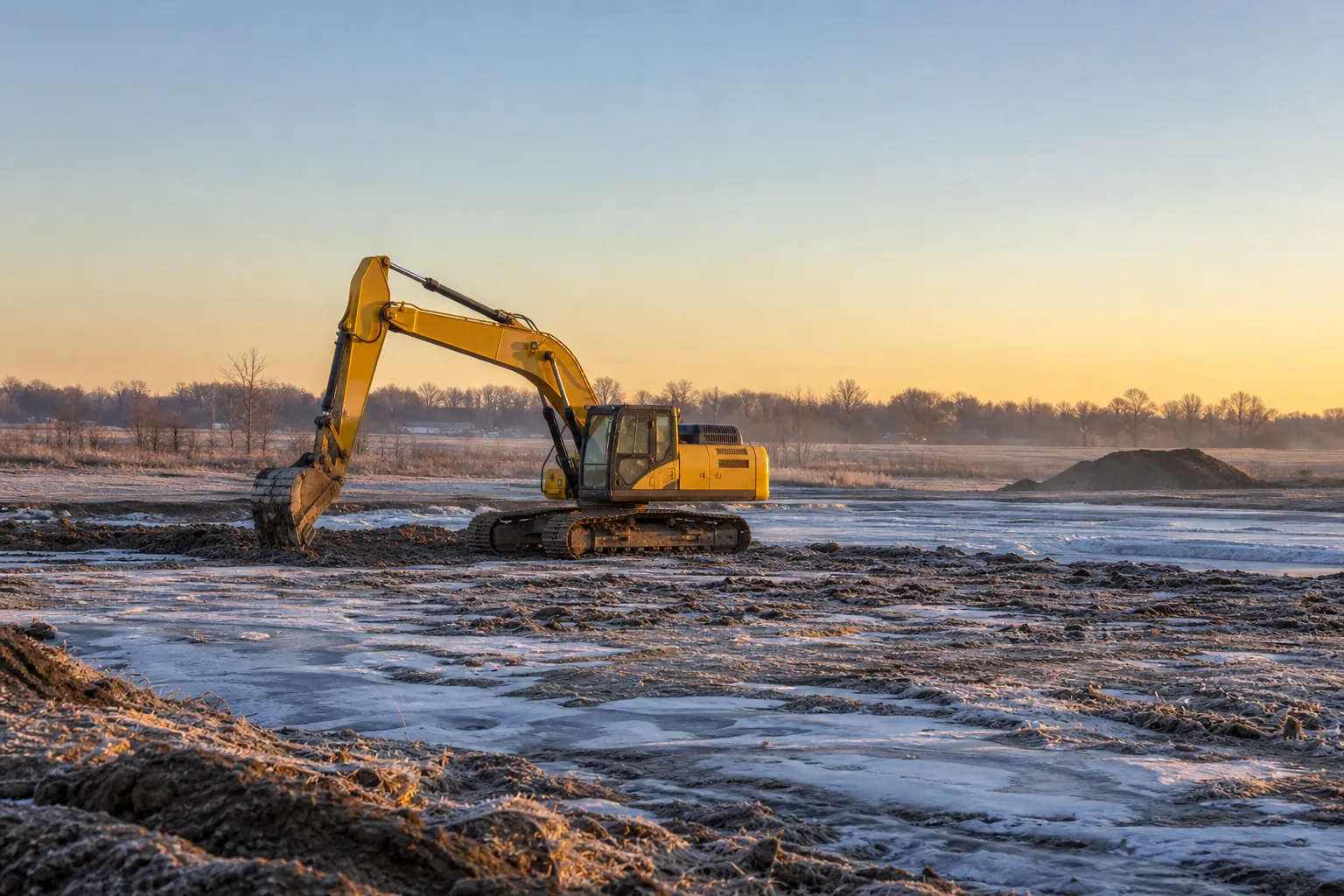
Frost depth ranges from an inch or two in the mid-South to five feet or more in Minnesota and North Dakota, and frozen soil digs like weak concrete. Crews add a frost ripper or hydraulic breaker to punch through, which can tack $100–$200 per hour onto machine time while production drops.
Then there's trucking. From roughly February into May, most northern states enforce seasonal load restrictions — frost laws — that cut legal axle weights to around 65–80% of normal while roadbeds thaw. Hauling the same 200 cubic yards of spoil takes more trips, and every trip is billable.
Put together, winter earthwork in the frost belt typically quotes 25–50% above the identical job in October. South of the frost line it's a different story, which we'll get to.
Thawing ground plus spring rain equals saturated soil, and saturated soil is miserable to work. Machines rut lawns and gravel drives, trucks bog down, and rain days stack up — losing a third of the working days on a wet April site is common.
The bigger problem is invisible: wet soil won't compact to spec. If your project puts structural fill under a slab, driveway, or foundation, compacting soggy clay is how you buy settlement cracks two years later. Wet material also hauls heavy — soaked clay can run 3,000 pounds per cubic yard against roughly 2,200 dry — so disposal costs climb too.
June through August offers the best digging conditions of the year, and that's exactly the problem — everyone knows it. Residential excavators commonly book four to eight weeks out, quotes come in at peak-season rates, and small jobs get bumped for bigger ones.
If your project has a hard summer deadline — a pool ready for July, a foundation ahead of a fall framing crew — get on a schedule by March. Waiting until June to call is how a two-day dig becomes an August problem.
August through November, before the ground freezes, is usually the cheapest and fastest window. Soil moisture is at its yearly low, backlogs thin out after Labor Day, and contractors start hunting for work to carry crews toward winter — some will knock 10–15% off to fill an October slot.
For scale, a typical 2026 residential job — grading, a utility trench, or prep for a garage slab — runs about $1,500–$7,000, while a full basement excavation lands closer to $12,000–$25,000 depending on soil and access. Booking that basement dig in September instead of May means fewer weather delays and a real shot at pouring footings before the freeze.
Winter isn't a dead season; it just filters the work. Frozen ground is a liability for foundations but an asset for anything that benefits from a firm, stable surface.
What shouldn't run in a hard freeze: footings and foundations without cold-weather concrete measures, septic systems, and any fine grading you want to survive the thaw. And anything involving deep trenches, frost breaking, or digging near gas and water lines is where a licensed contractor like Acme Excavation should take over — 811 locate rules and trench-shoring requirements don't relax just because the ground is hard.
So: get quotes in late summer, dig in the fall, and save winter for the short list above. Same hole, better price, fewer surprises.